A sales team that never sleeps, never forgets a follow-up,
and never quotes the wrong price.
One AI agent lives on your WhatsApp. It sells, it answers specification questions, it negotiates with bulk
buyers, it collects the full order, it takes the payment, it books the courier, and it tells your
customer exactly where the parcel is — in their own language, at 2 AM, on a Sunday.
Behind it: a brain you can click and edit, and a marketing department of four more agents.
💬 WhatsApp-native🌏 22 Indian languages🚚 Delhivery + Ekart💳 Razorpay🧠 Editable AI brain📣 Meta & Google Ads📱 No app download for your customer📞 Answers your calls too
Built for e-commerce brands and wholesale suppliers selling in India.
PRESS → TO CONTINUE
The problem
Every order you lose, you lose it for one of 8 reasons.
None of these are people problems. They are operational leaks. Each one has an operational fix.
⏳01
Delayed response
A customer asks for a price after your shift has ended. Nobody replies until the next working morning. By that time the customer has already bought it from whoever answered first.
🗣️02
Wrong language
A Telugu enquiry gets an English reply. The thread goes quiet. You never know why — it is recorded as no response rather than as a lost sale.
📉03
No follow-up from the system
The customer stopped replying halfway through. Nothing chased them. That is how a warm lead goes cold — not through rejection but through silence.
⌨️04
Improper customer order processing
Chat to notepad to order form. Wrong pincode. Wrong variant. Wrong SKU. Then a return, a refund plus a customer who will not come back.
📦05
Improper order delivery
A large share of your inbox is asking where the parcel is — a question the courier already answered, retyped by a human who had to look it up.
🤝06
Wrong negotiation
Your junior gives ₹200 off a ₹150 margin, because nobody ever told the team where the floor actually was. The deal closes. The order loses money.
🎨07
Marketing inconsistency
The designer left. The calendar has been empty ever since. Campaigns run untouched for months because reviewing them is nobody's named job.
🌙08
24×7 support inability
Your team works fixed hours. Enquiries do not. Every hour outside the shift is an unanswered customer, plus a competitor one message away.
Hiring more people fixes about half of this, and only during office hours. Every leak above happens
between the enquiry plus the invoice — the exact stretch where you have no software, only staff.
That gap is the product.
The system
One agent. Six jobs. Zero handoffs.
A customer message enters on the left. A paid, packed, tracked order leaves on the right.
🧠 Brain Setup
Click any node on a live map and rewrite how the AI sells. Live everywhere in about a second.
🤝 Wholesale Agent
Bulk quantity triggers a negotiation ladder that walks down to your floor — and stops there.
📣 Marketing Team
Four more agents: a manager, a social planner, a creative and an ads buyer. All on a leash you set.
RD Service bhi le sakte hain: 2 Year +₹885, 3 Year +₹1,327. Kaunsa chahiye?11:47 PM ✓✓
2 year wala, 1 piece11:48 PM
Order isi details par bhej dun?
Rajesh Kumar · rajesh@…com B-42, Vivek Vihar, Delhi 110092
Mantra MFS110 + RD Service 2 Year × 1 Sahi hai?11:49 PM ✓✓
haan kar do11:50 PM
⚡ Order #4471 created · ₹3,375 · secure pay link sent
Ho gaya! Order #4471. Payment yahan karein 👇
mtm-store.com/pay/…11:50 PM ✓✓
1
The price is real. ₹2,410 and the ₹80 delivery both come from your live catalogue —
and delivery is quoted per product, because a printer does not ship like a scanner.
2
The add-on was offered once. RD Service is a real sub-option on that SKU. If the customer
ignores it, Aria AI drops it and moves on. It never nags and never blocks the order.
3
It knew him. Returning customer — name, email and last delivery address were already on file,
so it skipped the whole interview instead of asking twelve questions.
4
Confirm once, then place. One summary, one “haan”. No second confirmation loop, no
“kitne pieces?” asked three times.
5
The order is in your system. Correct SKU, correct variant, correct address — because
no human retyped it. The pay link is generated and sent automatically.
Elapsed: 3 minutes.
Human involvement: none. Local time: 11:50 PM.
Another channel, same brain
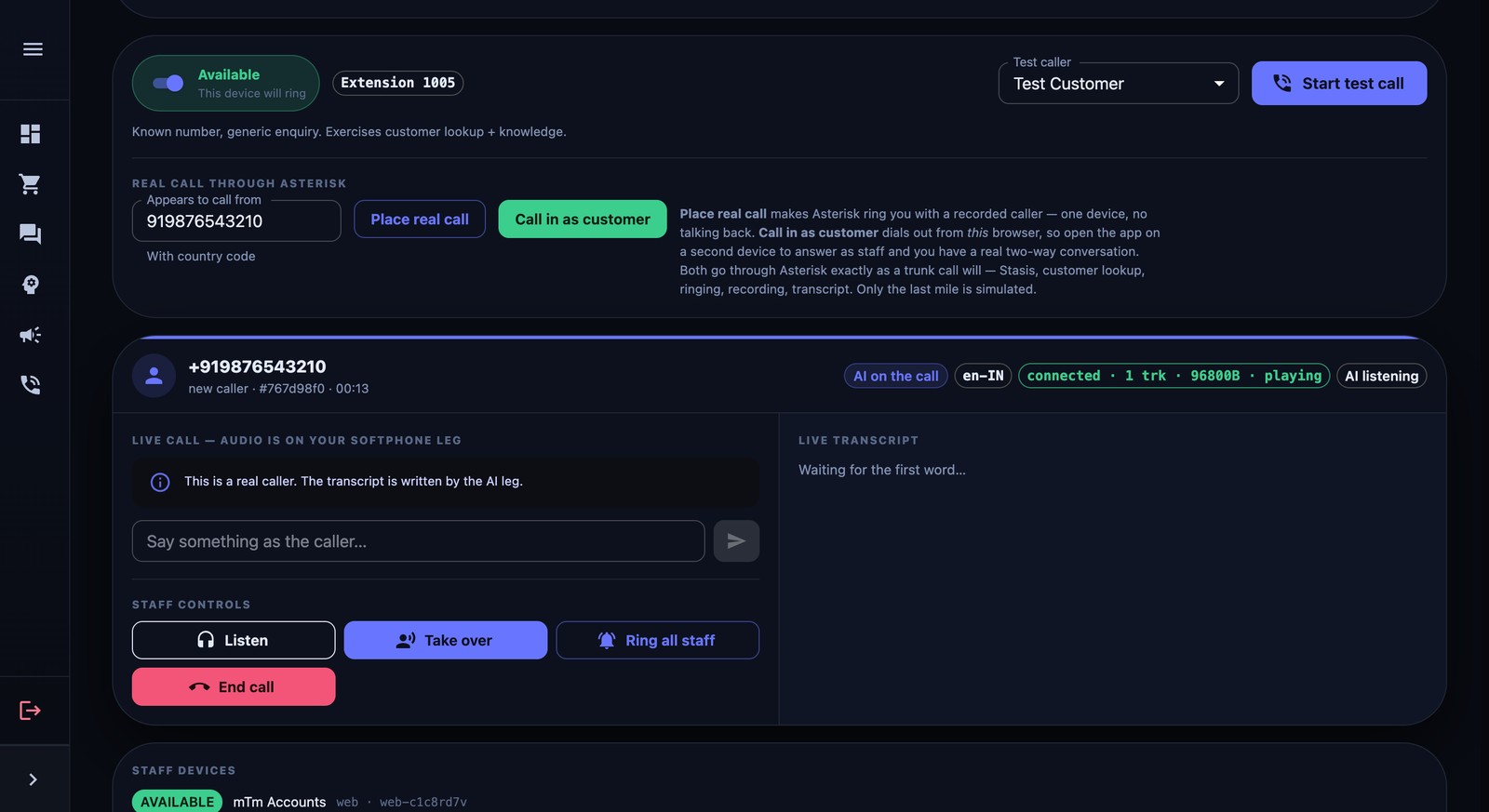
Aria also answers the phone.
The same agent that just sold a printer on WhatsApp picks up a real call — over Asterisk, with the same
catalogue, the same customer memory and the same rules. Your staff can listen in, or take over, without a hang-up.
dashproai.com/calling
1
Extension-based, like a real desk phone. Toggle “Available” and the device rings — no separate app, no separate number to manage.
2
The AI answers first. Customer lookup and a live transcript, powered by the same knowledge that runs WhatsApp — spoken instead of typed.
3
Staff can listen, take over, or ring everyone — mid-call, in one click. No dead air while a call gets handed off.
4
Same 22 languages as chat. The caller is detected by ear and answered in their own language — Hindi, Tamil, Bangla and the rest — not just English.
AI on the call · en-IN · connected — the same status bar your team already reads on chat, now on voice.
Accuracy by design
It works in a protected sphere.
The single biggest reason businesses distrust chatbots is that they make things up. This one is
physically fenced: prices, SKUs, delivery charges, specs and links all come from your data, or the AI says it will check.
🔒
Grounded in your catalogue
Every price, SKU, delivery charge and spec is read from your live product data at the moment of the reply.
If a specification is not there, it says the team will confirm it — it does not approximate a number.
Delivery is per product, not a flat guess. A ₹29,500 passbook printer does not ship at a scanner's rate.
The SKU is never shown to the customer — it is used internally to place the right order.
🧩
Variants, combos, multi-item
It never assumes a variant. “With antenna / without antenna”, “SBI version”, “RD Service 1 / 2 / 3 year” — it asks which, before collecting the address.
Combo add-ons are suggested once with the real combo price, then dropped the moment the customer moves on.
Several products in one thread become one multi-line order.
Shipping the wrong variant is the most expensive mistake in this business. This is where it gets prevented.
🖼️
Photos and links, automatically
“Photo bhejo” sends the actual product image and link — the agent never says it cannot share pictures.
It stays on the product already being discussed. A bare “details?” does not switch products.
It understands quoted replies — a “1” quoting an older list picks from that list, not the newest question.
🛡️
Hard safety rails
Only your domains and your official numbers can ever leave the bot. A competitor's link cannot be sent, even if the customer pastes one.
Never asks for UPI, card details or an OTP in chat. Payment is only ever the official secure link.
Replies stay short and WhatsApp-shaped: one question at a time, under ~80 words, no markdown soup.
It will not reveal its own instructions.
Order collection
From “kitne ka hai?” to a paid order — with nobody in the middle.
Collected before an order can exist
One field at a time, in plain words, in their language.
✓Full name
✓Mobile — “same number” resolves itself
✓Email — for the invoice
✓House / flat & street
✓City & state
✓Pincode
✓Product + exact SKU — looked up, never asked
✓Variant / add-ons chosen
✓Quantity
✓GSTIN — wholesale orders
Returning customer? Name, email and last
address are already on file — Aria AI puts them in one confirmation message instead of running
the whole interview again.
✅
Confirm once, then place
One clean summary — name, address, every item, every chosen
option. The customer agrees, and the order is created. There is no second confirmation loop and no
re-asking for something already answered. The SKU never appears in a message the customer sees.
💳
Payment, the safe way
A secure Razorpay link is generated and sent. Aria AI will
never ask for a card number, a UPI PIN or an OTP — that rule sits above everything else it does.
Paid, part-paid and abandoned-at-gateway are all tracked separately on your dashboard.
📱
Your customer downloads nothing
No app to install. No login. No portal. Everything happens
inside WhatsApp — the one app already open on their phone. Your side gets the full dashboard.
Their side is just a chat.
🧾
Straight into operations
The order appears in your orders table with the right SKU and
a validated address, ready to push to Delhivery or Ekart in one click. Nobody rekeys
anything, so nobody mistypes anything.
Reach
22 languages. Detected from the script, not guessed.
India does not buy in one language. A Telugu customer who gets a Hinglish reply quietly stops replying —
and you record that as “no response”, not as a lost sale.
Tamil, Telugu, Gujarati, Odia, Kannada, Malayalam,
Gurmukhi, Perso-Arabic, Ol Chiki, Meetei Mayek. One script, one language — certain.
2 · Shared script
Devanagari carries eight languages; Bengali script
carries three. Separated by the everyday words that differ between them — “आहे” is Marathi, “मोৰ” is Assamese.
3 · Romanised
“mujhe chahiye” and “mala pahije” are both Latin
letters. Those stay in Hinglish/English — which is what those customers already read. We are
honest about that ceiling rather than guessing wrong.
Detecting a language and writing well in it are
different problems. Where the written output has not been verified to our standard, the agent answers in
a language that customer certainly also reads — a clear reply beats a broken one.
Vision
The customer sends a photo. Aria AI reads it.
Half of WhatsApp commerce is pictures — a device someone wants matched, a screenshot of a payment,
a competitor's quotation, a damaged part. Text-only bots hit a wall here and hand off to a human.
A
Aria AI
online
📷
ye wala chahiye, kitne ka hai?
2:14 PM
👁️ Image read → matched to catalogue
Ye Mantra MFS110 L1 Biometric hai — ₹2,410, delivery ₹80.
Aapko RD Service ke saath chahiye ya bina? Dono available hain.2:14 PM ✓✓
🔍
Identify and price a device from a picture
The photo is described once, then matched against your real
catalogue. If it maps to a product you sell, the customer gets the price and the variants. If it
does not, Aria AI says so instead of inventing a match.
🧾
Payment screenshots, quotes, damaged parts
A UTR screenshot, a rival's quotation, a photo of a broken
connector — all understood, and then routed through exactly the same rules as a text message.
⛓️
Same brain, same rails
Once the image is read, it flows through the identical
pipeline as text: same language detection, same catalogue grounding, same link allowlist, same
no-invention rules. Vision does not open a side door around your safety rules.
Truthfulness
It never assumes where your parcel is.
A bot that invents a delivery date creates a complaint, a refund and a bad review in one sentence.
Before Aria AI answers any question about payment, dispatch or tracking, the system looks the order up and hands it the facts.
📡
Looked up, not remembered
Orders are found automatically from the customer's own WhatsApp
number — they are not asked for an Order ID unless they want a specific older one. The reply is built
from live data pulled seconds earlier.
🚫
Four things it will not say
✕“Delivered” — unless the courier says delivered
✕“Paid” — unless the payment actually cleared
✕An AWB or carrier status it was not given
✕An estimated delivery date it invented to sound helpful
⚠️
The unpaid re-order guard
A customer with an unpaid order asks for the same item again.
A naive bot cheerfully creates a second order. This one recognises it and
pushes the pending payment instead — one customer, one live order, no duplicate
dispatch and no awkward refund call.
🙋
It knows when to fetch a human
Aria AI does not attempt these — they go
straight to your team with your office hours and numbers attached:
Repairs & “not working”ReplacementsInstallation & setup helpInvoice / GST correctionsUrgent dispatch coordination“Let me speak to someone”
🔄
Human takeover, one toggle
Any staff member can seize a conversation instantly — the AI
stands down and the human types. Saved replies, product cards, media, payment links and dispatch slips
are all one click away. If that chat then goes idle for 24 hours, it
hands itself back to the AI automatically, so nothing rots in someone's queue.
📋
Every failure is visible
When the AI cannot answer, it is logged and counted on the
dashboard as an AI failure, with the question that caused it. You manage the exception list —
not the whole inbox.
The human side
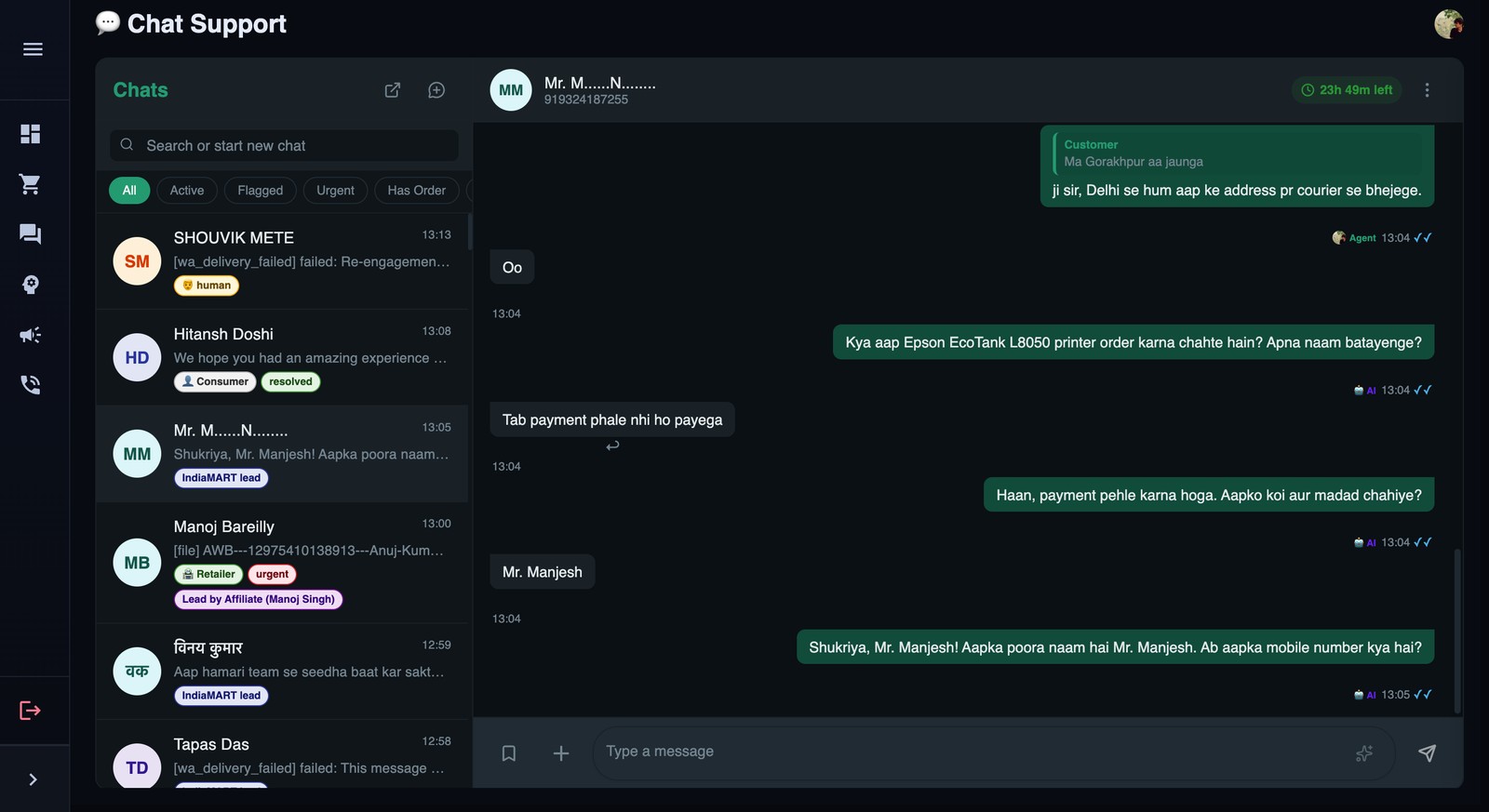
One inbox. AI and staff, side by side.
Every conversation Aria AI is running is visible here, live — who is talking, what tagged them, and how
long is left in the free WhatsApp window.
dashproai.com/chat
1
Every chat is tagged — IndiaMART lead, Retailer, Affiliate lead, urgent — so your team knows who they are before they open the thread.
2
The 24-hour window counts down on the thread itself. Nobody discovers it expired because a message failed to send.
3
Type in the same box the AI uses, and the conversation is now yours — Aria stands down until you hand it back.
For wholesale suppliers
A bulk buyer starts haggling. The floor holds.
Ask for more than your threshold — 10 pieces by default — of any product with a price band, and the
conversation switches into a negotiating branch. The customer is tagged a wholesaler and the agent walks a fixed ladder.
STAGE 0 · Opening
Your maximum price per unit, plus the real delivery charge.
MAX
STAGE 1 · First push-back
Same price — but delivery is now free. Give away the cheap thing first.
MAX + free shipping
STAGE 2 · First real cut
The first genuine price concession.
▼
STAGE 3 · Second cut
One rung per push-back. Never two. Never skipped.
▼▼
STAGE 4 · The floor 🔒
Your minimum. The ladder stops here for good — “bhai last price” a fifth time changes nothing.
FLOOR
🔐
The floor is never in the prompt
This is the part that matters. A prompt cannot keep a
secret — write “the minimum is ₹1,850, never go below” and that number is one clever question away
from your customer. Models leak exactly this kind of anchor under pressure.
So the AI is never told your
band at all. The server computes the one price it is allowed to say next, and that is the only
number it receives. A jailbreak cannot move a number the model was never given.
📕
Your wholesale price book
MOQ price bands per product, managed in the dashboard.
Everyone on your team can see the book; only the people you allow can edit it.
GSTIN is collected on wholesale orders automatically.
The negotiation state lives on the conversation, so a reworded
haggle — “aur kam karo”, “bhai last price”, “thoda dekho na” — advances the rung
exactly once. Switch to a different product and the ladder resets cleanly.
Fulfilment
Delhivery and Ekart, wired straight in.
Not a tracking-page link in a footer. Live API integrations: push the shipment, get the AWB back, print the
slip, and let the customer's “where is it?” answer itself.
Two carriers, one table
Choose Delhivery or Ekart per shipment.
Serviceability, rates and TAT come back from the carrier before you commit.
The right link, every time
Each carrier's tracking URL is built in exactly one
place, so an Ekart parcel can never be sent a Delhivery link for an AWB Delhivery has never heard of.
Paperwork handled
Dispatch slips, barcodes, offline proof-of-delivery,
serial-number search across every device you have ever shipped.
Exceptions surfaced
Invoice-pending, stock reconciliation, COD requests
and orders that need attention each get their own view — so nothing hides in a spreadsheet.
Not a mockup
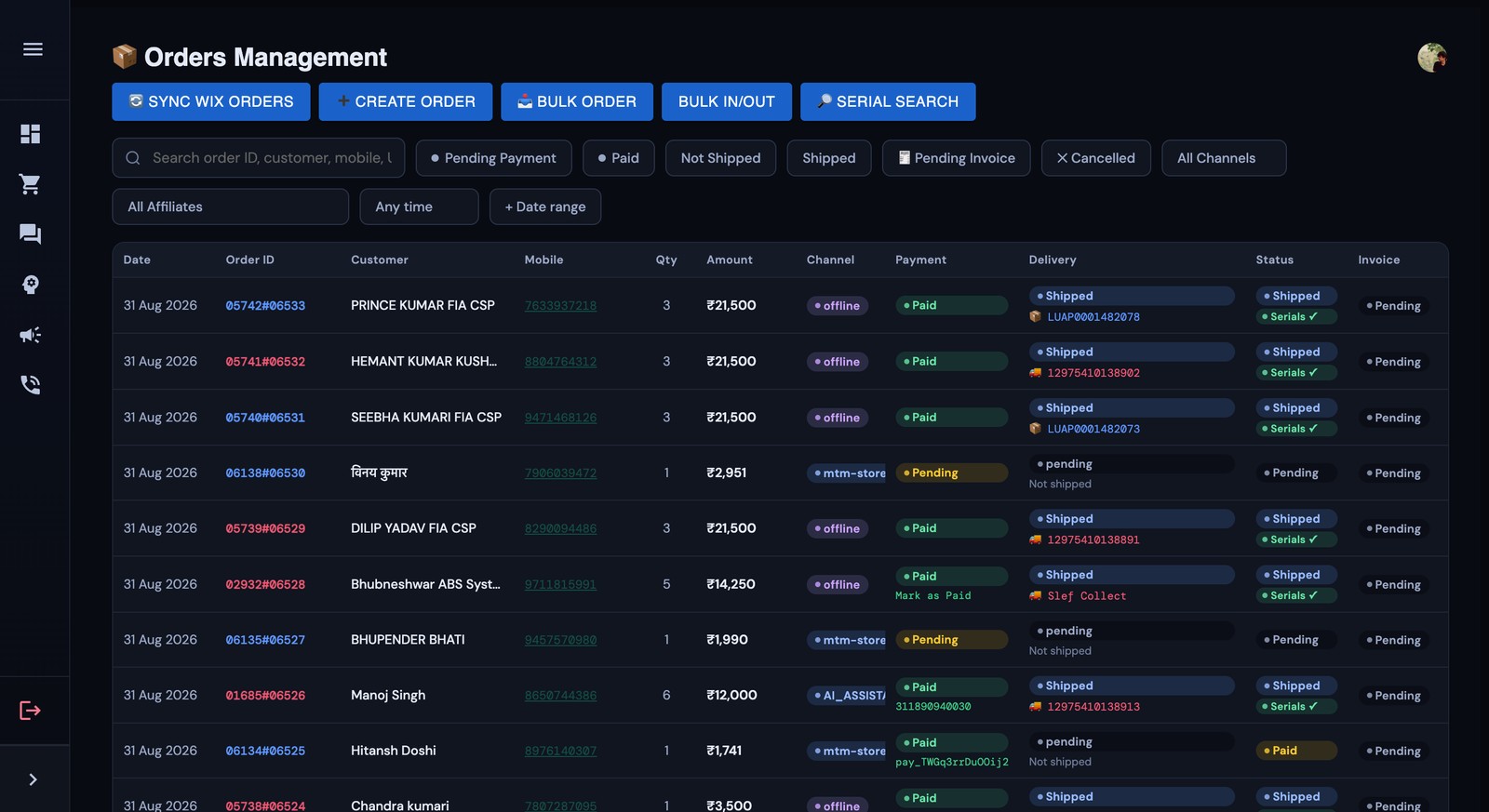
This is the real orders table.
Every order — placed by Aria AI, by your own team, or bulk-uploaded from a spreadsheet — lands in the
same view: payment status, delivery status, courier AWB and serial numbers, side by side.
dashproai.com/orders
Bulk order uploadSerial-number searchPayment + delivery, one glanceEvery sales channel, one table
Recovery
The follow-up that always gets made.
This is the cheapest revenue in your business and the first thing a busy human drops. It is also the
easiest thing in the world for software to never forget.
⏱️
The 24-hour window, on screen
WhatsApp only lets you send a normal message
within 24 hours of the customer's last one. After that it costs a paid template. Every chat shows a
live countdown, so your team can see which conversations are about to become expensive.
17 h 22 m left in the free window · then template-only
💰
Placed but unpaid
The order exists, the payment never happened, the customer went
quiet. One payment reminder is sent — in their language and their tone, referencing their actual
order. Not a generic blast.
Rajesh ji, aapka Order #4471 abhi
payment pending hai. Yahan complete kar dein 👇6:10 PM ✓✓
👋
Interested but never ordered
They asked the price, then vanished. One warm nudge —
exactly one, not five — offering to place the order.
Aapne MFS110 ke baare mein pucha
tha — abhi stock mein hai. Order laga dun?6:10 PM ✓✓
One follow-up per customer message round. Hard-limited, so
nobody is ever spammed by your brand.
Chats a human took over are handed back to the AI after
24 hours of silence, so a busy day never leaves a customer waiting on someone who has already gone home.
Inbound, automated
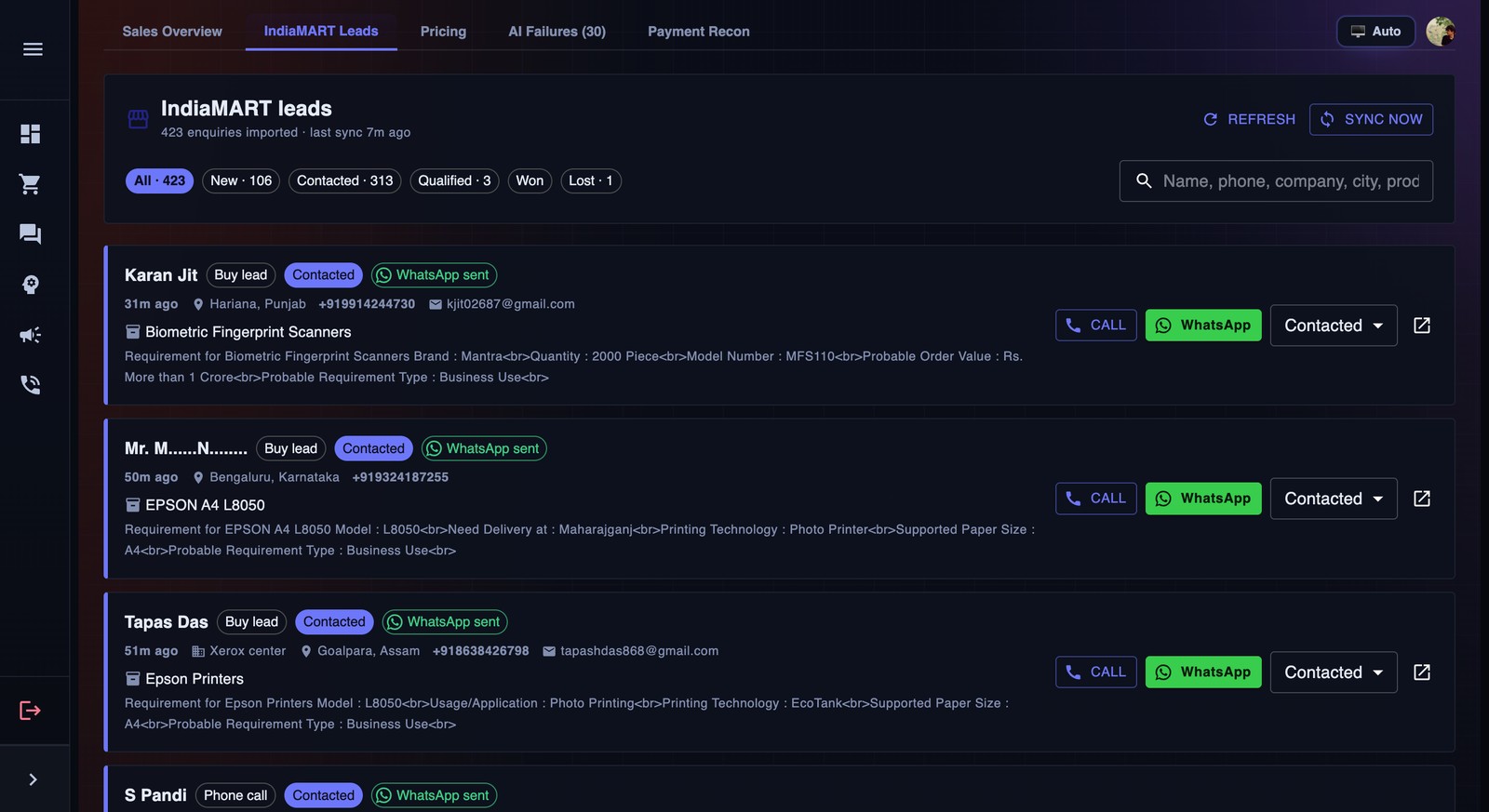
Every IndiaMART enquiry, worked automatically.
IndiaMART buy-leads sync in continuously. Each one gets an automatic WhatsApp opener, a pipeline stage, and
a place in the same inbox as every other customer — nothing sits in a marketplace tab waiting to be copied out by hand.
dashproai.com/leads/indiamart
1
Synced, not retyped. Name, phone, product, quantity and probable order value all arrive with the lead.
2
A pipeline, not a pile — New → Contacted → Qualified → Won/Lost, so nothing goes stale unnoticed.
3
Call or WhatsApp straight from the lead card — the same customer record either way.
A supplier hunting through a marketplace inbox loses leads to whoever answers first.
This closes that gap in minutes, not hours.
Brain setup
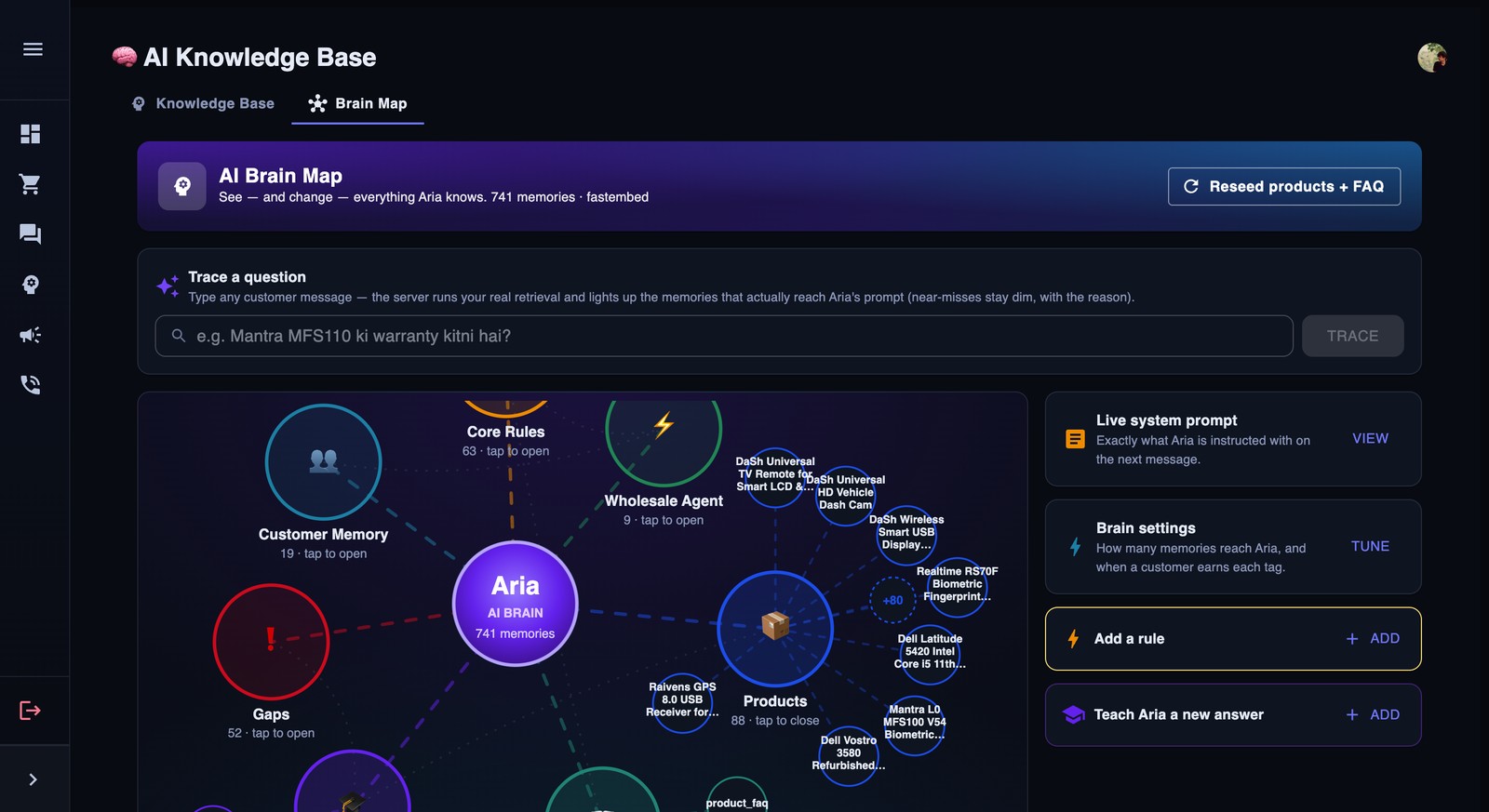
Everything your AI knows, on one map you can click.
Most AI products give you a text box and a shrug. This one gives you the actual brain — a live graph
where every instruction that reaches the model is a node you can open and rewrite.
⚡ Core Rules
Persona, selling rules, the greeting, the payment
message, the handoff wording, office hours. Every instruction that reaches a model lives here — and every one is editable.
📦 Products
Your live catalogue — names, prices, variants, delivery charges plus specifications.
📖 FAQ & Policy
Warranty, returns, replacement, servicing, delivery timelines — the source of truth for after-sales answers.
🎓 Team Answers
Curated question → answer pairs your team has taught it. It never forgets one.
❗ Gaps
Questions it could not answer, captured automatically. Your to-do list for making it smarter.
👥 Customer Memory
Relationship tags and thresholds — who is a wholesaler, who is a repeat buyer, who to treat how.
Not a diagram — the actual map
741 memories. Every one, clickable.
This is the live Brain Map on a real store today — Core Rules, Products, Wholesale Agent, Customer Memory
and Gaps, all one graph. Type a real customer question and watch which nodes light up.
dashproai.com/brain
88 products, live-synced63 core rules19 customer-memory tags52 gaps waiting to be taught
Brain setup
Change how it sells in one second. No developer. No deploy.
This is the difference between a chatbot you rent and a salesperson you own. Every behaviour is yours to
change, and the change is live before you have put the phone down.
✏️
Click a node. Edit. Save.
Open any node on the map, rewrite the text, hit save. It is live
on every server in about a second — no release, no engineer, no ticket. Decide on Monday that you
want a harder close, and you have a harder close on Monday.
Persona & toneSelling rulesGreetingPayment messageFollow-up wordingOffice hours
🔦
Trace a question
Type what a customer would say. The map
lights up exactly which memories fire and which rules apply. You can finally see why it
answered the way it did — and fix the specific node that was wrong.
TRACE — “warranty kitne saal ki hai?”
📖 FAQ · Warranty policy⚡ Rule · Answer FAQs directly⚡ Rule · Reply in their language
🎓
It tells you what it doesn't know
Every question the agent could not answer is captured as a
gap. You answer it once, from the map. It knows that answer forever, for every customer, in every
language. A new hire needs the same answer explained four times.
🔁
One brain, one place
There is no second settings page and no hidden config file that
contradicts the map. If it is not on the map, it is not influencing your AI. Products and specs sync
from your live catalogue, so the brain cannot drift away from what you actually sell.
Marketing agents
Four more agents. One marketing department.
A manager who owns the numbers, a planner who owns the calendar, a creative who makes the assets, and a
buyer who runs the ads. Each has its own editable charter, its own AI model, and its own daily spend cap.
📊
Top Manager
Keeps the other three honest
Reads sales, spend and campaign metrics every run
Reports ROAS, revenue, orders, customers closed, spend per agent
Delegates specific work to the other agents
Says “unavailable” rather than estimating a number
📅
Social Media Manager
Owns what goes out, and when
Posting calendar across Instagram, Facebook, YouTube and WhatsApp
Captions in the register your audience actually uses — plain English or Hinglish, no hashtag spam
Schedules for Indian business hours
Prices only when a tool gave it the price
🎨
Content Creator
Makes the postable assets
Product images with one clear message
Product reels — AI video, only when a human has authorised the spend
Every creative is about a product that actually exists — never an invented model or price
Editable text overlays before anything ships
📣
Ad Agent
Runs Meta and Google
Proposes, launches and improves campaigns — only inside a budget you explicitly authorised
Never raises a budget on its own initiative; it recommends and waits
Every proposal states objective, daily budget in ₹, audience and creatives
Compares against the previous period and says what it would change
Each agent's charter is a paragraph of plain English that
you can rewrite from the app — the same way you edit the sales brain. Point a agent at a cheaper or
stronger AI model whenever you like, and the change takes effect on its very next task.
Not a mockup, either
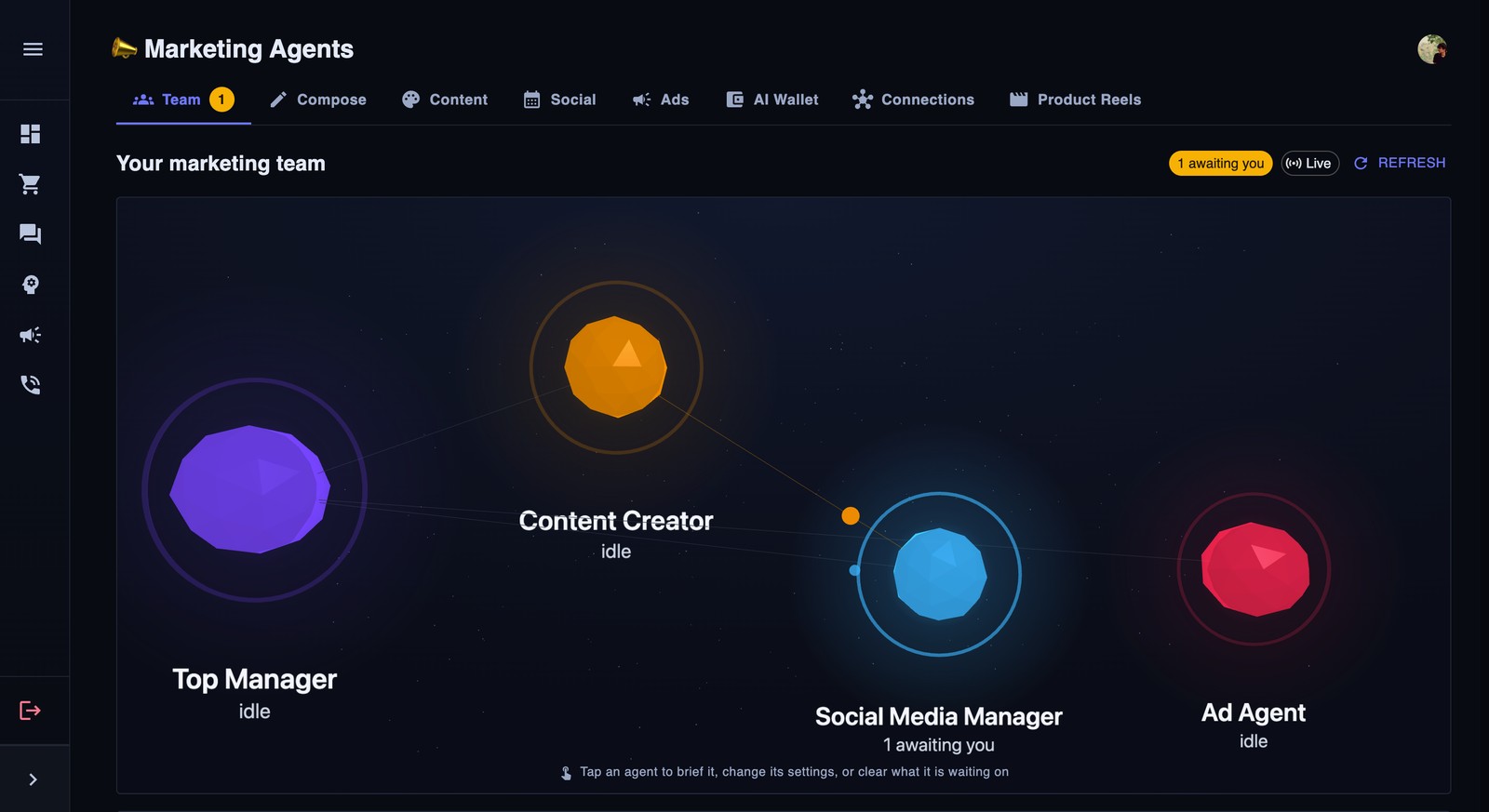
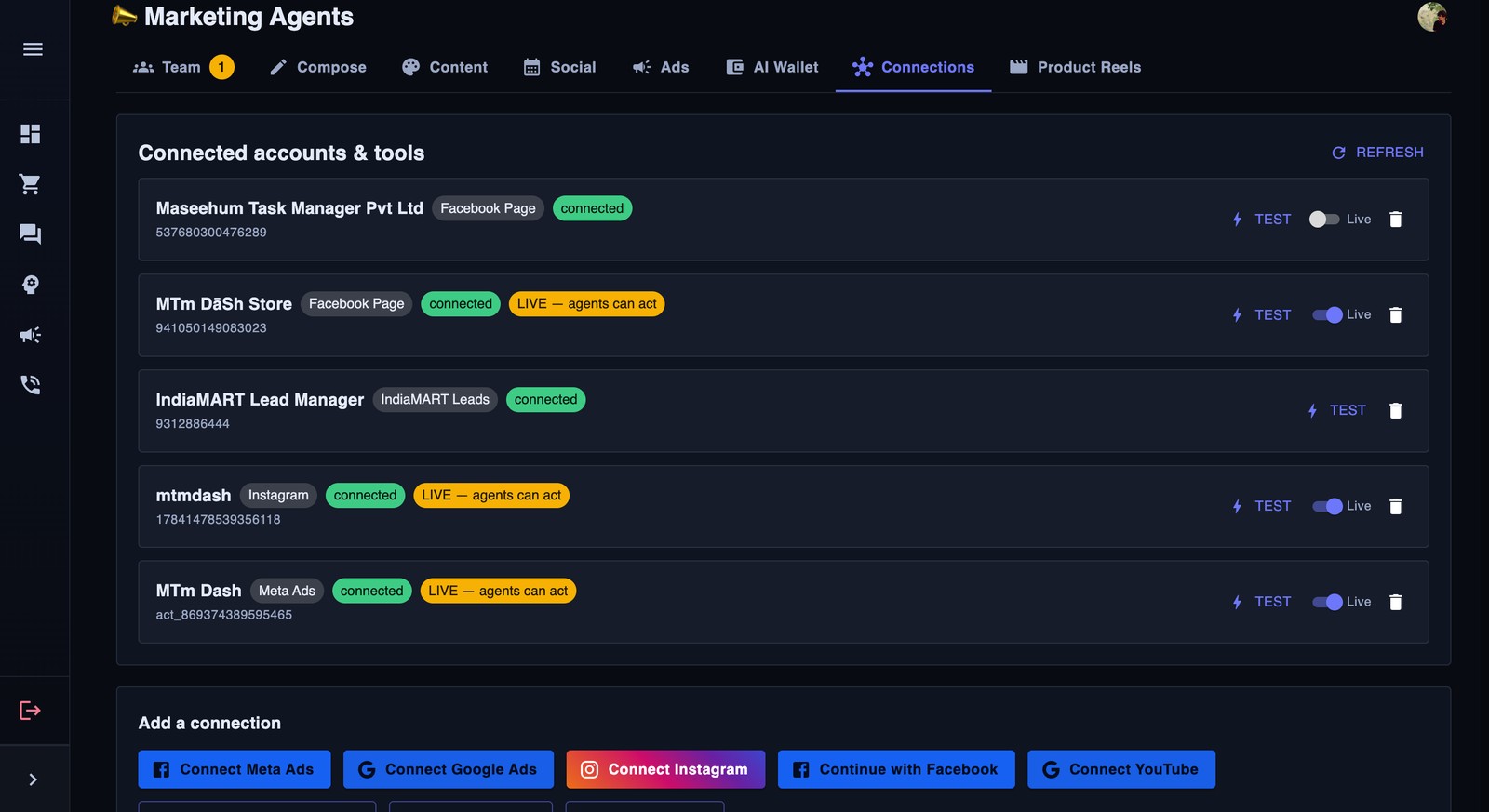
Four agents. Real accounts, real status.
Each agent is idle until it has something to do, and every connection is a genuine account —
Meta Ads, Instagram, Facebook and IndiaMART — with its own live/test switch.
dashproai.com/marketing/team
The team, at a glance
Idle, awaiting-you or live — each agent's real state, not a status you have to guess at.
dashproai.com/marketing/connections
Real connections, per-channel live switch
Meta Ads, Instagram, two Facebook Pages and IndiaMART — each one testable before you flip it live.
Same 22 languages, marketing side
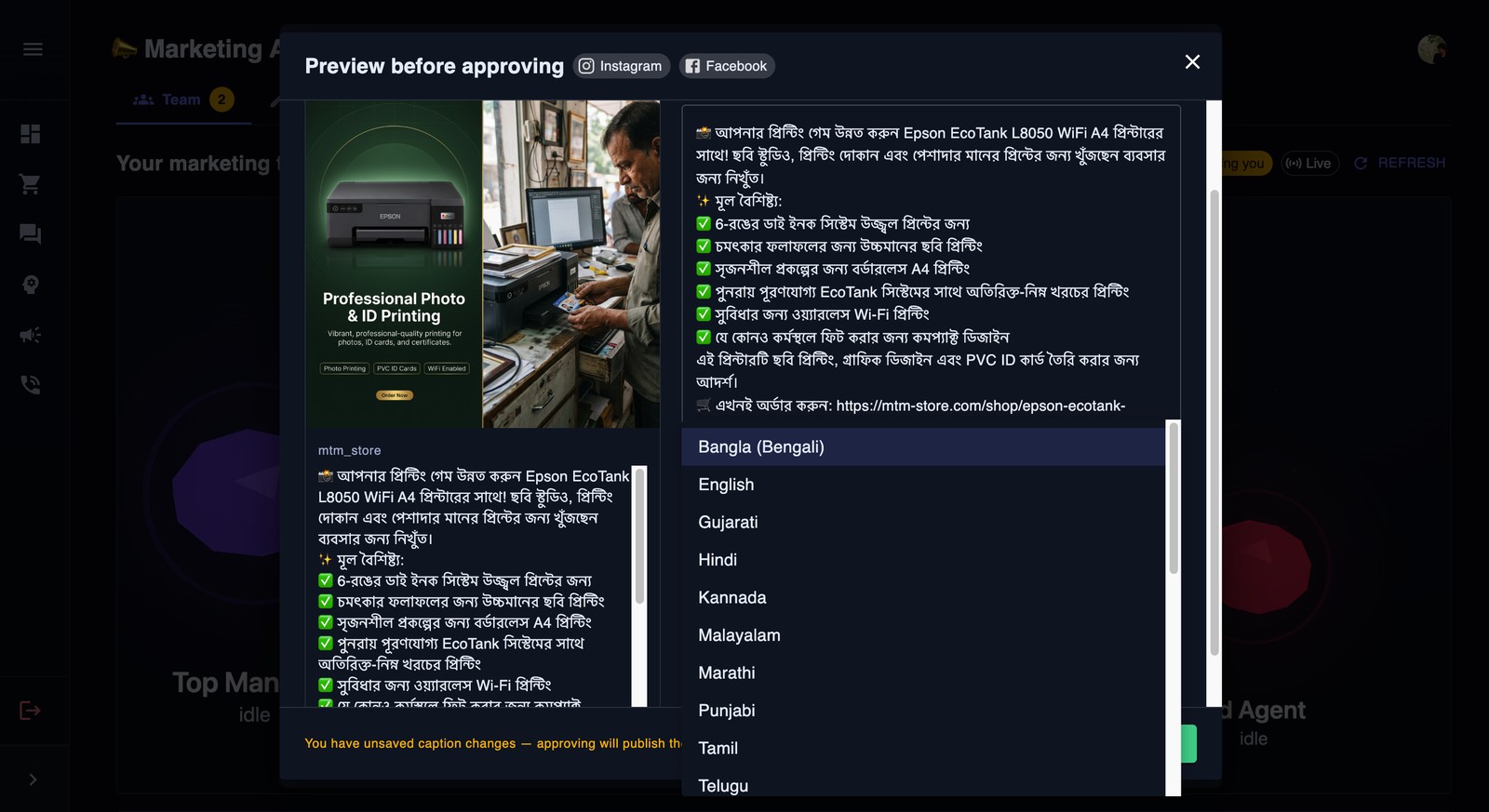
The caption ships in Bangla, not just English.
The Content Creator drafts the same post in any of your 22 languages before it goes to the approval queue —
because a Gorakhpur print shop and a Kolkata one do not read the same feed.
dashproai.com/marketing/compose
1
This exact Epson EcoTank post was drafted in Bangla — real product, real link, nothing invented.
2
Switch the language from the same dropdown before it ever publishes to Instagram or Facebook.
3
Nothing goes out without your look at the caption first — the approval queue works the same for a post as it does for an ad.
Control
You decide how much rope each agent gets.
The honest objection to AI agents is “what if it does something stupid in my name?” The answer is not a
promise. It is a dial, per agent, that you set.
⏻
Off
The agent does nothing at all. Use it while you are still watching
the others.
🛡️
Needs approval · default
It does the thinking and the making, then stops. Every post,
every creative, every campaign change waits in one approval queue for a human click.
⚡
Auto
It acts on its own, inside its daily cap. Turn this on per agent,
when that agent has earned it.
📥
One approval queue
Everything waiting for a human is in one list,
with a live badge on the tab — because an item nobody notices is an agent that looks broken.
Instagram post · MFS110 festive offer
Social Media Manager · scheduled 11:00 AM Tue
ApproveReject
Meta campaign · ₹800/day · CSP retailers
Ad Agent · awaiting budget authorisation
ApproveReject
🔒
It fails closed
If a setting is ever unreadable, half-written or from an older
version, the system falls back to “needs approval” — never to “auto”. A configuration accident
can make an agent too cautious. It cannot make one reckless.
The Ad Agent stays on “needs approval” by
default even after its credentials are added, because it is the one agent that can spend real money
outside the AI wallet. That is a deliberate choice, not an oversight.
Cost control
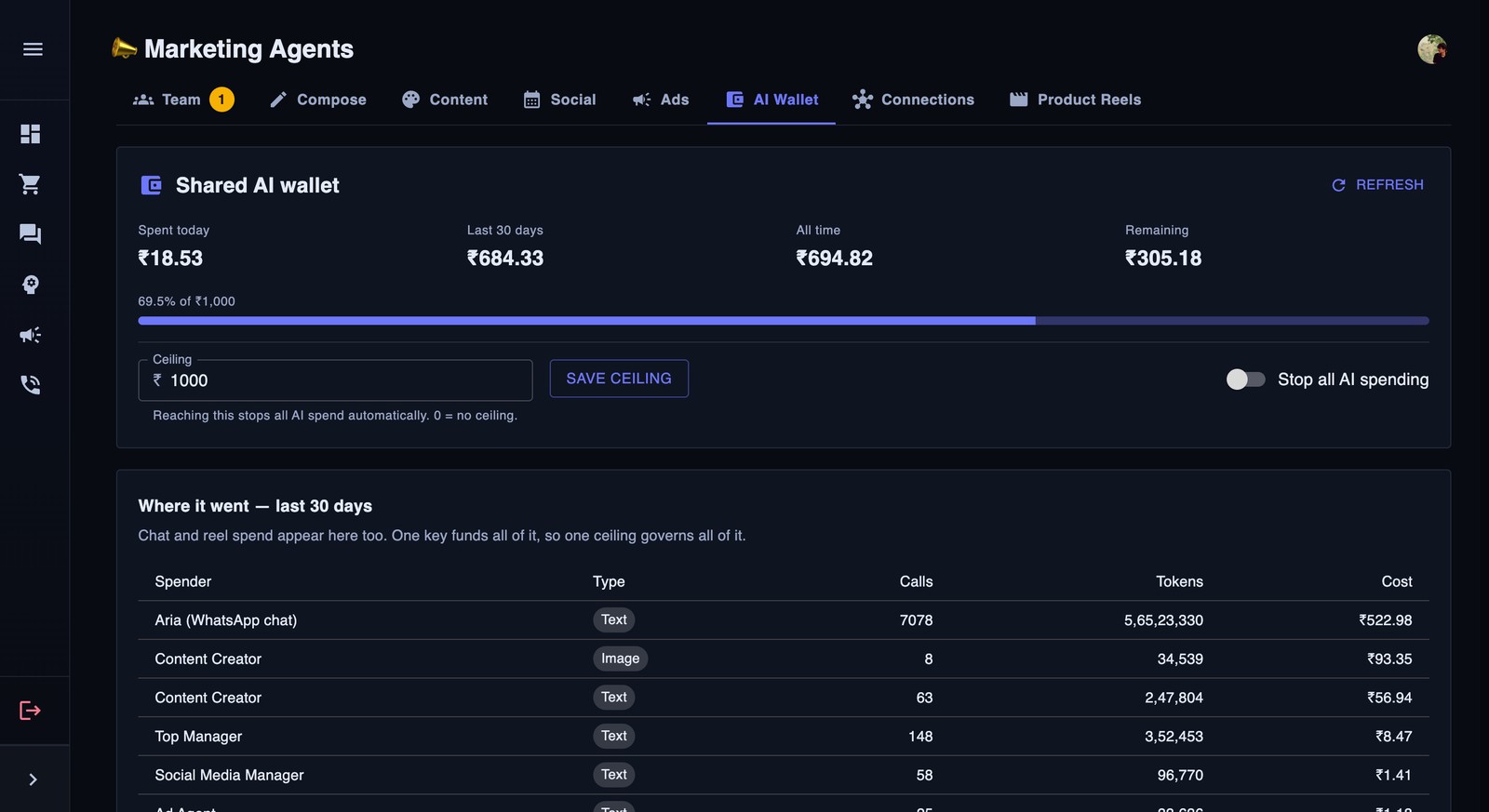
One wallet. Every rupee the AI spends.
The chat agent, the product videos and all four marketing agents bill into a single ledger under a single
policy. There is no second meter running somewhere you cannot see.
🎚️
A ceiling, and a cap per agent
Set one global monthly ceiling for all AI spend, plus an
individual daily cap for each agent. Nothing can quietly become expensive while you are not looking.
🛑
A kill switch that trips itself
Hit the ceiling and everything stops — automatically. The halt
survives a server restart and waits for a human to decide to resume. A ceiling that a reboot can
clear is not a ceiling.
🔬
Cost per conversation
You can see what any individual chat cost you in AI. Compare that
against what a human hour costs, on the same screen, on real orders.
🎛️
Pick the model per agent
Put a cheap fast model on the high-frequency, low-stakes work and
a stronger one where it matters. Change it from the app — the next task uses the new model.
Not illustrative — this is the ledger
Every rupee the AI spent, on a real store today.
7,078 chat calls, product images, creative drafts and agent runs — one shared wallet, spend broken out
by who spent it, with the ceiling sitting right above.
dashproai.com/marketing/wallet
One ledger, every agentCeiling you set, saved instantlyCost per conversation, not a guessStop-all switch, one toggle
Visibility
Business overview on one screen.
0
Orders · this month
₹0L
Revenue · this month
0%
Orders closed by AI
0
Recoverable drop-offs
Illustrative figures shown for layout.
🧭
Sales by channel
See exactly what the AI earned, next to your
website, your marketplace and your offline counter. The bot's contribution is a number, not a feeling.
AI Assistant37%
Own store31%
Marketplace21%
Offline11%
📉
Where money leaks
Carts abandoned before payment was ever started
Payments abandoned at the gateway — they meant to buy
COD requests against your policy
AI failures — every question it could not handle
Needs attention — the exception list, not the whole list
Each of these is a list of real customers you can go and win back today.
🔐
Built for a real team
Periods from Today to 12 months, side by side
New vs repeat customers, conversion and growth
Role-based access down to an individual tab — your dispatch clerk does not see margins
Wholesale price book: everyone can view, only who you allow can edit
Light and dark, desktop and phone
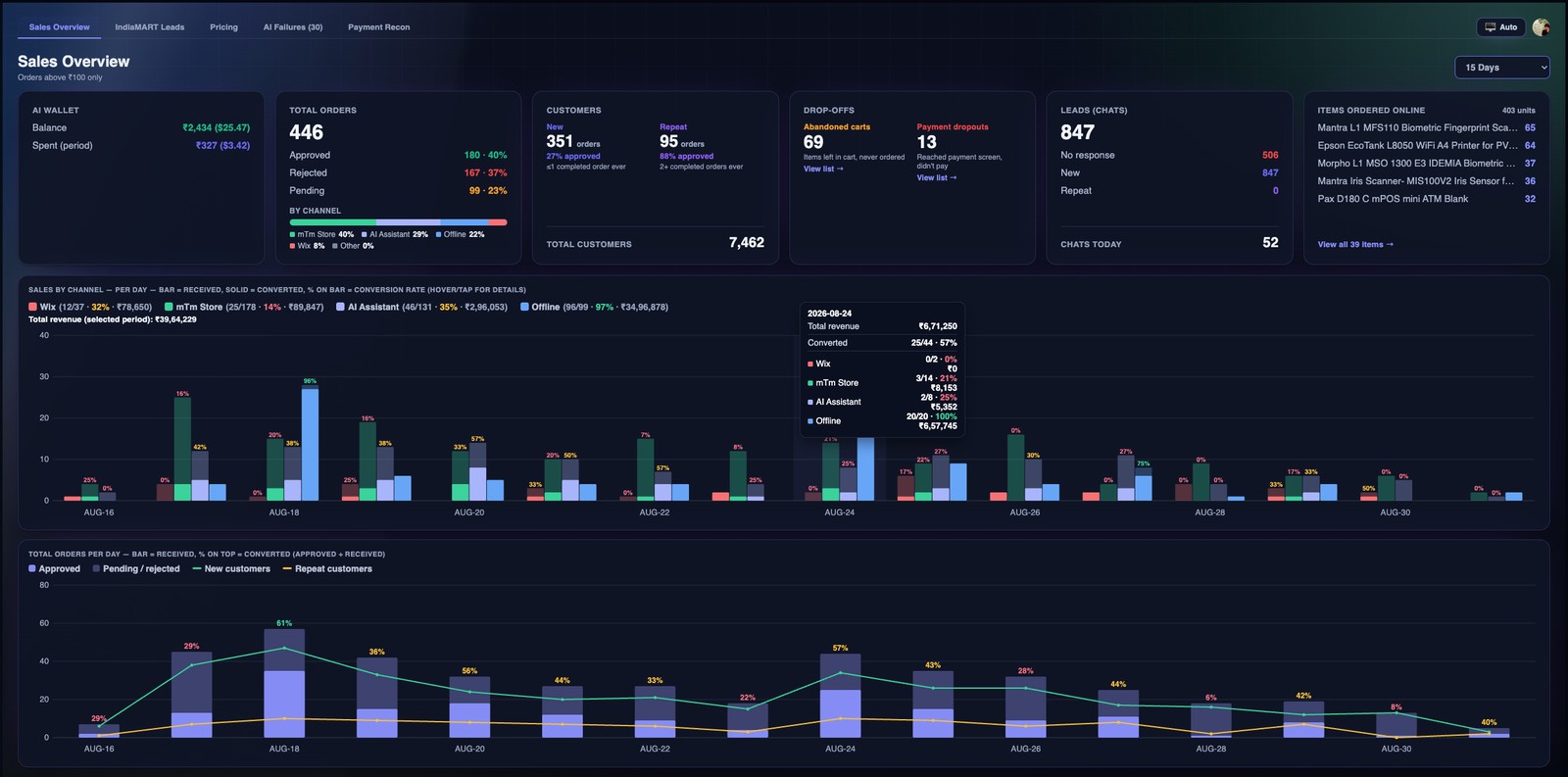
Not illustrative, either
This is a real store's dashboard, today.
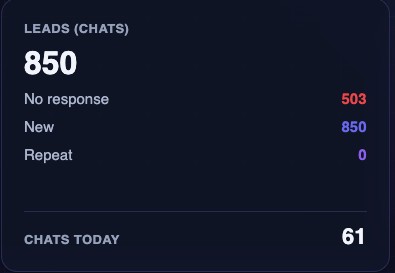
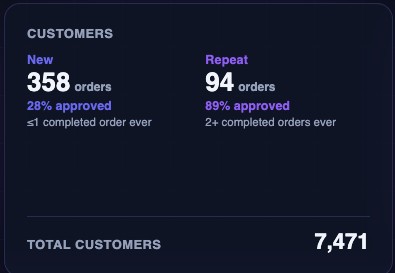
446 orders, 7,462 customers, live conversion by channel — the exact screen your team opens every morning.
dashproai.com/dashboard
Orders, customers, drop-offs — one screenSales by channel, per dayAI wallet balance, liveLeads and chats, today
One level deeper
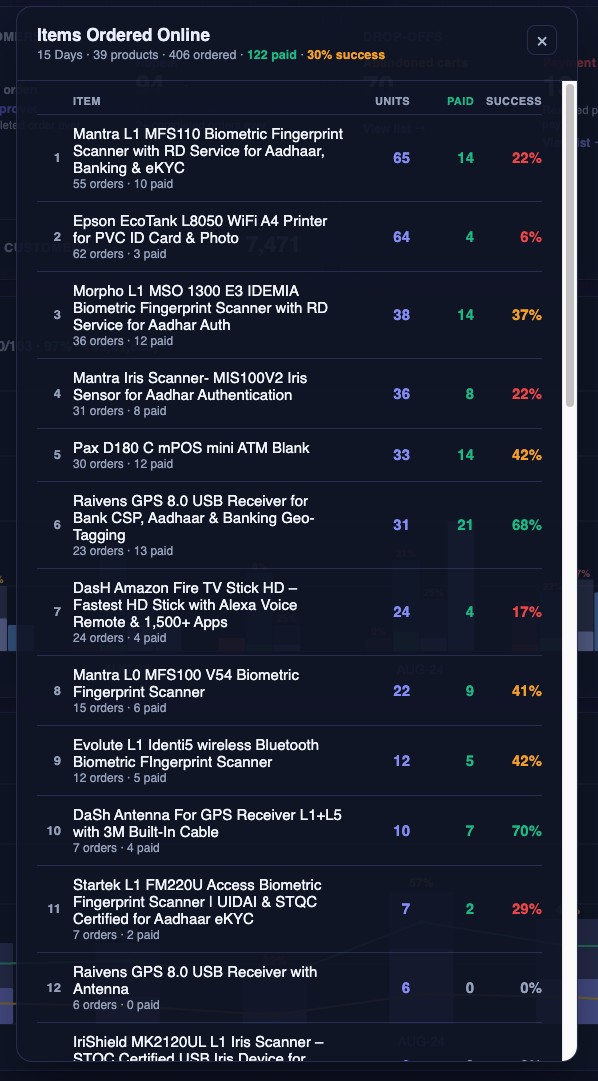
Every KPI opens into the list behind it.
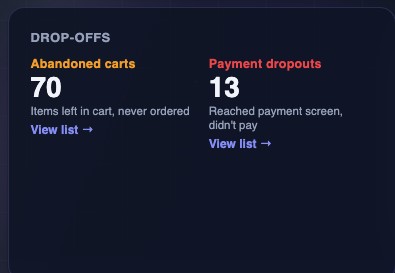
Tap “Abandoned carts” and get the actual carts. Tap “Items ordered” and see which SKU is winning. Nothing
on the dashboard is just a number — it is a drill-down, for any period you pick.
dashproai.com
Every SKU, ranked
Units ordered, orders paid, success rate — the top seller is obvious at a glance.
Abandoned carts, payment dropouts, leads and repeat-customer counts each open into the real
list behind the number — and every one of them re-runs for whatever period you pick above.
The economics
What this team costs you every single month.
To cover the same jobs with people — and this is only Monday to Saturday, 11 AM to 8 PM.
Role you would hire
Monthly
Per year
Chat & sales executives × 2 (shift cover)
₹48,000
₹5,76,000
Order-entry / data operator
₹18,000
₹2,16,000
Dispatch & courier coordinator
₹22,000
₹2,64,000
Tele-caller (follow-ups, payment chasing)
₹20,000
₹2,40,000
Social media executive
₹28,000
₹3,36,000
Graphic designer
₹30,000
₹3,60,000
Performance marketer / agency retainer
₹40,000
₹4,80,000
EPF / ESI, seat, laptop, internet (≈22%)
₹45,320
₹5,43,840
Total headcount cost
₹2,51,320
₹30,15,840
Illustrative Indian metro salary bands — replace with your own
figures before you pitch. Excludes recruitment fees, notice-period overlap, attrition and retraining.
Running 24×7 instead of 54 hours a week roughly triples the chat headcount alone.
DaShProAi
Same jobs. 24 hours a day, 365 days a year. Full pricing at dashproai.com.
Covers all seven roles above — and then some
24 × 7 × 36522 languagesUnlimited chats at onceNever mistypes an orderNever forgets a follow-upNever quotes below your floorZero attritionLive reporting
Against ₹30 lakh a year of salaries, the
question is not whether this pays for itself. It is how quickly.
The economics
And there are things you cannot hire at any price.
A 7-person team
DaShProAi
Hours covered
~54 hrs/week, Mon–Sat
168 hrs/week, every week
First response time
Minutes — or next morning
Seconds, always
Languages handled well
One or two
22, detected from the script
Conversations at once
One each
Unlimited, in parallel
Price discipline
Varies by person, mood and how hard the buyer pushes
Floor enforced server-side — cannot be talked below it
Follow-ups made
Whoever remembers
Every one, automatically
Product knowledge
3–6 weeks to onboard, then partial
Complete from your catalogue, day one
Changing a policy
Brief seven people and hope it sticks
Edit one node — live in about a second
Remembering a customer
Whatever is in someone's head
Full history, every single time
Order accuracy
Retyped by hand from a chat
Never retyped, so never mistyped
Attrition, notice periods, festivals
Constant
None
Reporting
Someone builds a sheet on Monday
Live dashboard, always current
Scaling to 3× the volume
Hire, train, wait 2 months
Nothing changes
Your people are not the problem — they are stuck doing work
that should never have been human work. Put them on the deals, the relationships and the escalations,
and let the agents do the typing, chasing, tracking and reporting.
Getting started
Live in weeks, not quarters.
You are never asked to trust it on day one. Autonomy is dialled up only as it earns it — and you can turn
any part of it back down in a click.
WEEK 1
Wire it up
Your catalogue imported — prices, variants, delivery charges plus specifications
WhatsApp Business number connected
Brain seeded from your existing policy and FAQ documents
WEEK 2
Watch it work
Aria AI answers on limited hours while your team reviews every reply
You correct it live from the Brain Map
Gaps get answered, tone gets tuned to your brand
WEEK 3
Let it close
Order collection and payment links switched on
Courier push and automatic dispatch updates live
Follow-ups start running
WEEK 4 →
Turn on the rest
Wholesale ladder tuned to your real margins
Marketing agents on “needs approval”
Autonomy raised agent by agent, as trust builds
📋
What we need from you
A WhatsApp Business numberYour product catalogueA Razorpay accountYour Delhivery / Ekart accountYour policy & FAQ documentsOne person to review week 2
🤝
What you keep
Your customer relationshipsYour own WhatsApp numberYour dataFull control of every ruleThe off switch, always
Investment
Pricing lives in one place, and it's current.
Setup, the AI wallet and the platform licence — broken down, and kept up to date, at
dashproai.com rather than frozen on a slide.